Since the World Boxing Federation was originally founded by American Larry Carrier in 1988, many of the sport’s biggest names have won a WBF title, and proudly defended the blue, red and gold belt all over the world.
In the Champions Of The Past Series we take a closer look at some of the boxers who held WBF titles in years gone by, from lesser known champions to world renowned fighters, legends of the sport and current or future Hall of Famers.
The West African Republic of Ghana has produced many prominent boxers over the years, including the legendary Azumah Nelson, former World Champions Ike Quartey, Nana Yaw Konadu, Joseph Agbeko and Alfred Kotey.
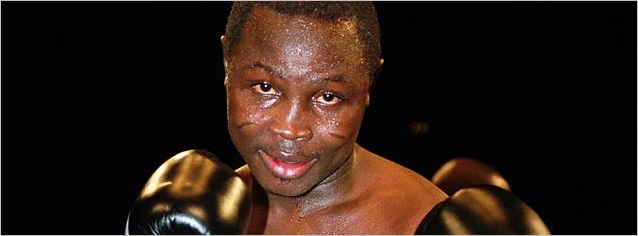
“Cobra” Kotey, a talented and hard-punching globetrotter who reigned as WBO World Bantamweight Champion between 1994 and 1995, is also a former World Boxing Federation (WBF) Intercontinental Lightweight Champion.
The oldest of five brothers and four sisters, Alfred was born on June 3, 1968 in Bokum, a small tribal locality in the heart of Ghana’s capital Accra, best known for its output of successful boxers. In that environment it was no surprise that he started boxing at a young age.
Quickly emerging as one to keep an eye on, he compiled a 35-4 amateur record, and despite the relatively few bouts he accomplished a lot, representing his country all over the world and reaching the quarter finals of the 1988 Soul-Olympics as a flyweight.
As is often the case with top amateurs, he decided to turn professional after returning from the Olympics, and had his first paid bout on November 26, 1988 sharing the undercard of a show at the Orion Cinema Hall in Accra with Olympic team-mate, and fellow debutant, Ike Quartey.
Kotey was on a fast-track with ambitions to reach championship level in quick time, and after winning his first four fights by convincing knockout, he further impressed by stopping Aristide Sagbo (10-3) from Benin in eight rounds in June of 1989.
Sagbo was coming off a victory over another Ghanaian, former Commonwealth Champion Sam Akromah, so it was a highly regarded triumph for Kotey, over a bigger opponent still in his prime, who would go on to twice win the African Super Featherweight title and make six successful defenses.
That victory put Kotey in line to fight for the vacant Commonwealth Flyweight title already in his sixth outing, and he proved a level above fellow countryman George Freeman, winning his first professional championship in just two rounds.
A low profile victory six month later would be his last fight in Ghana in over eight years, as he started a run of twenty-one outings, switching between Britain and America, by retaining his Commonwealth crown with a decision over Danny Porter (8-5) on July 6, 1990 in London-suburb Brentwood.
He then relocated to tradition-rich fighting city Philadelphia, where he became a regular on shows staged at iconic venue The Blue Horizon. After six fights in “the city of Brotherly love”, and two in Atlantic City, his record stood at 16-0 (12), and he had graduated to headlining status.
On November 17, 1992 Kotey suffered his first defeat as a pro, when he lost a split decision to underestimated Mexican Julio Cesar Borboa (16-4), a man who had fought no-one outstanding but still lost four times.
However, the loss would turn out to be no shame at all, as Borboa took the IBF World Super Flyweight title from Robert Quiroga in his very next fight, a defended his belt five times in the coming years. In fact, in retrospect, the encounter with Borboa was proof that Kotey was world class himself.
Moving up to Bantamweight, Kotey returned to England in March of 1994 to decision Journeyman Chris Clarkson (18-22-2). The following July he was awarded a shot at reigning WBO World Champion Rafael Del Valle (15-0) from Puerto Rico at York Hall in London.
Kotey, 26 years old the time and probably at his peak, put on an excellent display, and became a World Champion by out-boxing Del Valle. He really left no doubt, and won a unanimous decision with scores of 118-111, 116-111 and 116-112.
Now based in Britain, Kotey made title defenses against Mexican Armando Castro (43-15-3) and British Champion Drew Docherty (14-1-1), before losing his world title on points to former World Super Bantamweight ruler Daniel Jimenez (19-4-1) in October of 1995.
Less than seven weeks later, Kotey was back in the ring and ready to launch his assault on a new weight division, Super Bantamweight. At York Hall he captured the vacant WBC International title, out-scoring two-time world title-challenger Freddy Cruz (50-7-7).
Returning to the USA, A loss to contender Jesse Magana (18-4-2) followed before Kotey stayed relevant by besting tough Mexican Jorge Munoz Jr. (16-5-1). A respected name, he continued to get tough fights at world level, losing close decisions to Guty Espadas Jr. (21-2) and Adan Vargas (24-1-1).
In the fall of 1997 Kotey was offered the opportunity to move up in weight again, to challenge a young Juan Manuel Maquez (22-1) for the WBO NABO Featherweight title. Winning on points, Marquez showed on that night the potential that eventually made him a true legend, but Kotey was competitive for twelve hard rounds.
Having gone through a long and tough period with big fights in England and America, and only coming out with his hands raised in two of his last seven, Kotey decided to return to Ghana to rebuild his career as a Super Featherweight.
But he only managed to go 1-1-1 in three bouts on home soil, against mediocre opposition at best, and questions arose if his time as a top fighter had come and gone. But he still had one big victory in him, and that came when he returned to his former adopted home-town, London, in April of 2001.
At Lightweight, Kotey was considered a “name” for Birmingham´s Anthony Maynard (15-3) to add to his record, but the old dog still had some bite in him, forcing the favorite to retire in the sixth round to win the WBF Intercontinental title.
Unfortunately the victory didn’t quite resurrect the career of Alfred Kotey. He would continue to fight, on and off, for another eleven years, going as high as Middleweight. Amazingly, his career had spanned almost twenty-four years when he finally retired at almost 44 in 2012.
Between 2001 and 2012 he fought, and lost to, the likes of Acelino Freitas (29-0), Orlando Salido (21-8-2), Jose Miguel Cotto (23-0), Antonio Diaz (39-5-1), Victor Ortiz (14-1) and Anthony Peterson (20-0). Still durable, if nothing else, none of these world class boxers managed to stop Kotey inside the distance.
Despite the somewhat sad final part, where he lost nine of eleven fights, Kotey achieved so much in his 26-16-1 (17) career. Commonwealth, WBO World, WBC International and WBF Intercontinental titles, and fights against some of the biggest names of his era, is not a bad ledger to look back at.
Archive